Staff ID: Barbara Schwartz
Dana-Farber Cancer Institute | Internal Communications
Inside the Institute, Volume 31, Issue 6, published June 9th 2026
Role: Interviewer + Writer
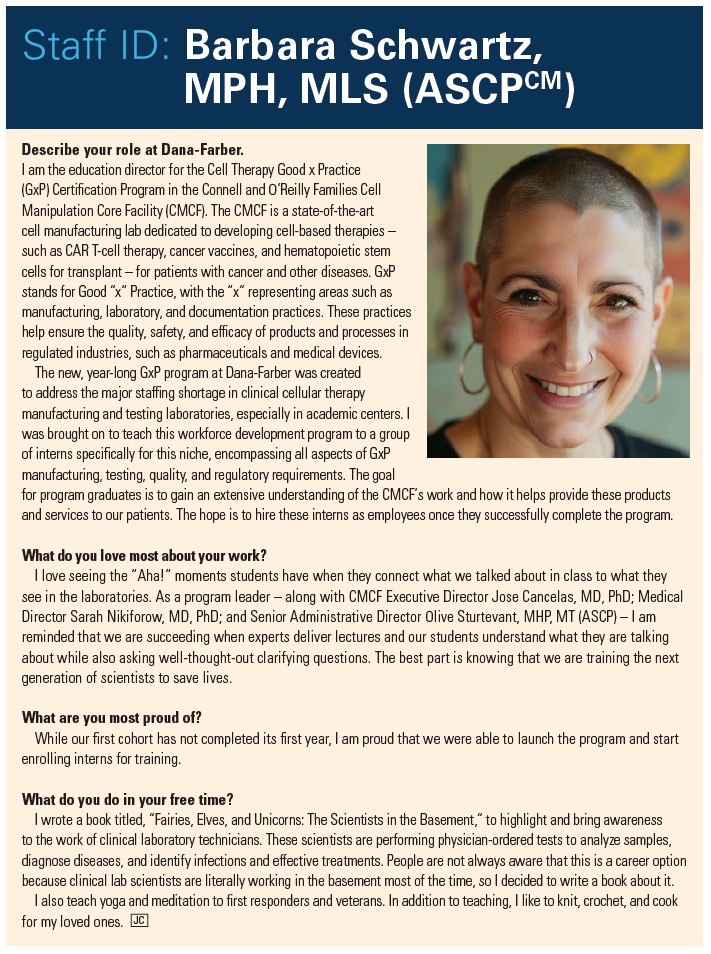
Describe your role at Dana-Farber.
I am the education director for the Cell Therapy Good x Practice (GxP) Certification Program in the Connell and O‘Reilly Families Cell Manipulation Core Facility (CMCF). The CMCF is a state-of-the-art cell manufacturing lab dedicated to developing cell-based therapies – such as CAR T-cell therapy, cancer vaccines, and hematopoietic stem cells for transplant – for patients with cancer and other diseases. GxP stands for Good “x“ Practice, with the “x“ representing areas such as manufacturing, laboratory, and documentation practices. These practices help ensure the quality, safety, and efficacy of products and processes in regulated industries, such as pharmaceuticals and medical devices.
The new, year-long GxP program at Dana-Farber was created to address the major staffing shortage in clinical cellular therapy manufacturing and testing laboratories, especially in academic centers. I was brought on to teach this workforce development program to a group of interns specifically for this niche, encompassing all aspects of GxP manufacturing, testing, quality, and regulatory requirements. The goal for program graduates is to gain an extensive understanding of the CMCF‘s work and how it helps provide these products and services to our patients. The hope is to hire these interns as employees once they successfully complete the program.
What do you love most about your work?
I love seeing the “Aha!“ moments students have when they connect what we talked about in class to what they see in the laboratories. As a program leader – along with CMCF Executive Director Jose Cancelas, MD, PhD; Medical Director Sarah Nikiforow, MD, PhD; and Senior Administrative Director Olive Sturtevant, MHP, MT (ASCP) – I am reminded that we are succeeding when experts deliver lectures and our students understand what they are talking about while also asking well-thought-out clarifying questions. The best part is knowing that we are training the next generation of scientists to save lives.
What are you most proud of?
While our first cohort has not completed its first year, I am proud that we were able to launch the program and start enrolling interns for training.
What do you do in your free time?
I wrote a book titled, “Fairies, Elves, and Unicorns: The Scientists in the Basement,“ to highlight and bring awareness to the work of clinical laboratory technicians. These scientists are performing physician-ordered tests to analyze samples, diagnose diseases, and identify infections and effective treatments. People are not always aware that this is a career option because clinical lab scientists are literally working in the basement most of the time, so I decided to write a book about it.
I also teach yoga and meditation to first responders and veterans. In addition to teaching, I like to knit, crochet, and cook for my loved ones.